India looks for model to unleash its surging ZLD market potential
The country has the regulations, the water stress and the industrial base to create the world's largest zero-liquid discharge market. GWI investigates why ZLD has struggled to gain traction, and why a breakthrough could be on the horizon.
India is looking to break down the hurdles to zero-liquid discharge technologies in its major cities and commercial hubs, as the country's swelling industrial base offers to create one of the most compelling water treatment opportunities in the world.
The country has regulatory pressure, water stress, and thanks to a wave of semiconductor fabs, solar gigafactories, and battery recycling plants, the kind of capital intensive, ZLD mandated industrial growth that is drawing serious technology investment. The harder question is why ZLD has not moved beyond compliance, and what it would take to unlock this market’s full potential.
The answer perhaps lies in three things that India is only beginning to build: consistent enforcement, next-generation treatment economics, and the downstream infrastructure that turns wastewater into a revenue stream rather than a disposal problem. None of the three is sufficient on its own. “It has to be a combination of all three,” said Siva Kumar Kota, head of technology at Gradiant, which has ZLD installations across India. “If technology is available but the policies are not there, it won’t work at all.”
A patchwork of rules, unevenly applied
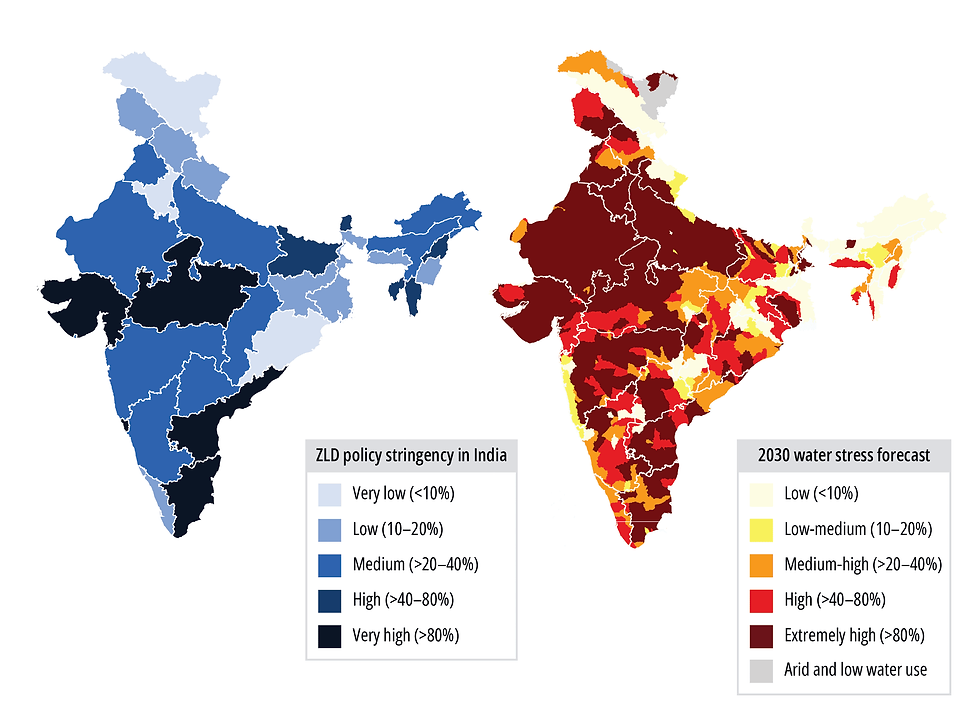
India’s ZLD regulatory landscape is more developed than it is often given credit for, but its patchwork character creates significant distortions in where and how the technology gets deployed.
India's water stress vs ZLD regulations by state
Source: WRI, National Green Tribunal, GWI analysis
The zld stringency score is enforcement-adjusted, not just based on policies on paper
The most stringent regulations are concentrated in the south and west. Tamil Nadu was among the first states to make ZLD mandatory for textile dyeing and bleaching and tanneries, and has since extended requirements to pharma and bulk drug clusters in sensitive areas. Gujarat’s Pollution Control Board has tightened norms for textile dyeing and printing in select industrial estates, and the state’s 2018 reuse policy adds a second layer of obligation around treated water offtake. Madhya Pradesh, Andhra Pradesh, and Maharashtra follow similar patterns, with sector-specific mandates and increasingly active enforcement in industrial corridors.
The picture is different in the north. Punjab and Haryana, both severely water-stressed, have formal reuse policies and cluster-level ZLD requirements, but adoption in MSME textile and dyeing units remains thin. Water prices are low relative to the cost of treatment, enforcement is inconsistent and smaller units, which make up the bulk of these clusters, simply do not have the financial capacity to invest in a technology whose economics depend on regulatory pressure to function. “The regulatory authorities and the industry are working in tandem in ways that do not always serve the public interest,” said Turbashu Bhattacharya, business unit head at Roserve, a ZLD provider, describing how some compliance is often nominal rather than real.
Across most states, ZLD requirements are starting to apply for new plant approvals and expansion permits. Existing plants, in many cases, are still running under older consent conditions. “If they are running as usual, enforcement is often limited,” Kota said. “But [for] anything new, or any expansion in that particular area, government is not giving approvals until you have zero liquid discharge.” The practical result is that the fastest-growing ZLD markets in India are not legacy clusters of tanneries and textiles, but the newer industries.
The challenge is that regulation alone has not been enough. For most Indian operators, zero liquid discharge remains a pure cost of compliance: high capital expenditure, energy-intensive evaporation, and no meaningful return on the solids the treatment process produces. Enforcement is uneven, particularly in the Micro, Small, and Medium Enterprise (MSME) -heavy clusters of the north, and the business case for ZLD depends almost entirely on regulatory exposure rather than commercial logic. “For many industries, there is no alternative but to implement effluent treatment, recycling, and ultimately ZLD to reduce water costs and avoid liquid discharge,” said Atul Tare, vice president at Praj Industries. “The high capex is one challenge, and the operational cost, particularly energy, is another major challenge.”
New industries, new opportunities
Solar manufacturing is perhaps the clearest example of the new dynamic. A decade ago, utility-scale solar production did not exist in India in any meaningful form. Today, facilities run by Adani, ReNew Power, and others operate across the country, all with ZLD requirements built into their environmental clearances. Foxconn’s iPhone assembly plant in Bengaluru is using Counterflow Reverse Osmosis (CFRO)-based ZLD systems alongside crystallisers, while Micron’s $2.75 billion semiconductor assembly and test facility in Gujarat is deploying ZLD technology from day one.
Food and beverage is a relatively new addition to the ZLD conversation, with protests in Chennai and other cities in 2017 over bottling plants’ use of groundwater during drought conditions forcing Pepsi, Coca-Cola and others to confront their water exposure. “From that time onwards, they anticipated that this may eventually apply to all plants, and gradually they are moving towards implementing [ZLD],” Kota said. “In the last five years, I have seen more food and beverage industries increasing water recycling and moving towards zero liquid discharge.”
Major market players in India
The competitive landscape remains fragmented, with a mix of global technology providers and domestic EPC players, leaving room for new entrants with differentiated solutions or financing models.
Company | Origin | Technology |
Thermax | India | Conventional thermal + modular ZLD |
Ion Exchange | India | Membrane + ZLD systems |
Praj Industries | India | ZLD systems |
Roserve | India | ZLD, MLD |
Gradiant | Global (US) | Advanced ZLD tech: CFRO (Counterflow Reverse Osmosis) and CGE (Carrier Gas Extraction) |
Veolia | Global (France) | Conventional thermal + modular ZLD |
Aquatech | Global (US) | ZLD systems |
VA Tech Wabag | India (listed) | Wastewater/ETP |
Source: GWI WaterData
The cost trap and the technology response
One thing that has defined the economics of ZLD in India is energy. Historically, India’s ZLD installations have relied on conventional thermal systems, particularly multi-effect evaporators (MEE), mechanical vapour recompression (MVR), and crystallisers. These systems remain widespread but are increasingly challenged by their high energy intensity and capital cost.
A new generation of technologies are beginning to reshape this landscape. Companies such as Gradiant are deploying lower-temperature evaporation systems and membrane-based approaches, including carrier gas extraction (CGE) and closed-circuit reverse osmosis (CFRO). These systems operate at significantly lower energy inputs and can reduce both capex and opex by roughly 30-40% compared to conventional configurations.
The shift is not just about efficiency. Modular, containerised membrane systems are also reducing deployment timelines from multi-year EPC cycles to less than 12 months in some cases, making them particularly attractive for fast-moving sectors such as semiconductors and electronics manufacturing.
However, adoption remains gradual. Thermal systems are deeply entrenched, and in many cases, hybrid configurations combining membranes with evaporation are emerging as a short-term fix rather than a full technological replacement.
Cost of compliance vs optimisation: ZLD economics across India and China

Costs vary significantly by salinity, technology configuration, and recovery integration
The resource recovery gap
Technology alone has not been the limiting factor in ZLD economics. The more decisive variable is whether treated waste can be turned into value. China’s experience shows how the build-out of industrial clusters, by-product markets and reuse pathways can transform ZLD from a cost centre into a value-generating system.
For example, in a man-made fibres plant in China, that infrastructure transformed the economics of ZLD through a single process change. A conventional ZLD train would have produced sodium sulphate crystals fetching around $14-$15 per tonne (RMB 100 per tonne), a modest return that barely dents operating costs. Instead, the plant installed a bipolar membrane electrodialysis system that converted the same brine for direct reuse. “With bipolar electrodialysis, we didn’t produce solid salt,” said Zhao Lou, chief engineer at Hangzhou Lanran Technology, which delivered the system. “We produced sulphuric acid and caustic soda for reuse in the production process, which helped the client save around $275-$420 per tonne (RMB 2,000-3,000 per tonne) on purchased caustic.” Payback was around 18 months. “Over the next two to three years, the biggest opportunity in China’s industrial ZLD market is the move towards resource recovery,” said Wu, chief engineer at Hangzhou Water Treatment Technology Development Center (HWTT). “It’s increasingly a value-creation business.”
India has not yet built that secondary market, and the economics of commodity salt recovery in India are less favourable than they might appear. Sodium chloride, the dominant salt in most industrial wastewater streams, is cheaply and abundantly available from India’s long coastline, which depresses the value of recovered material to the point where transportation is often the dominant expense. Higher-value salts like sodium sulphate, calcium chloride, boron compounds, bromides present a more interesting case. The textile sector is already showing early signs of demand: a small number of operators, aware that they import the same salts they are currently disposing of, are beginning to ask about selective recovery. “They are asking because they use sodium sulphate and sodium chloride and they don’t want to import so much salt.” Kota said.
The chloro-alkali pathway offers a more scalable route. Rather than recovering salt from individual industrial wastewater streams, the logic is to route concentrated brine to chloro-alkali producers, who can use it directly to produce caustic soda and hydrochloric acid, thus avoiding the energy and cost of dissolving purchased salt. Gradiant has piloted this model with one customer using seawater brine. However, it is the clustering of ZLD facilities and the presence of industrial parks with chemical producers that makes this viable. While that clustering is beginning to emerge in India’s new industrial zones, it is not yet systematic.
India’s emerging battery recycling and semiconductor manufacturing industries represent the higher-value end of the same opportunity. Semiconductor fabs generate complex chemical wastewater streams that, treated with the right technology, can yield acids and bases for internal reuse. Battery recycling flowsheets produce lithium-bearing sulphate solutions that BMED systems can convert into lithium hydroxide, a high-value output, not a waste stream. “After batteries are processed into black mass, the black mass is leached with sulphuric acid to produce a lithium sulphate-rich leach liquor,” said Lou. “With bipolar electrodialysis, that can be converted into lithium hydroxide and sulphuric acid. The acid is fed back into the front end, and the lithium hydroxide can be sold or converted into lithium carbonate depending on the product requirement.” India’s government has committed substantial investment packages to both sectors. The facilities being built now will bring with them exactly the wastewater streams where resource recovery logic applies most directly. The question is whether an ecosystem of technology providers, by-product buyers and industrial park planners, will be ready to capture that value, or whether the opportunity defaults to compliance-only thinking. “The most promising option is to produce acids or bases, that could actually outweigh the cost of the treatment system”, said Keith Ambrose, engineer at EPRI.
Building the ecosystem
The lesson from China’s ZLD market is that the combination of regulatory intensity and industrial clustering created the conditions for a secondary economy of by-product recovery that materially changed the economics of treatment. Salt buyers, acid markets, on-site chemical reuse loops: these are the features that allow Chinese ZLD operators to frame their systems as value-creation infrastructure rather than a pure cost of compliance.
India has the regulatory foundations, the industrial base, and the water stress that create demand for ZLD. What it is building, more slowly, is the ecosystem of technology options, financing models, and downstream markets that determine whether that demand translates into genuine market development. The enforcement gap is real, but developing industrial park design, by-product logistics and clustered chemical buyers would allow the economics of ZLD to look less like a compliance burden and more like an investment.
The new industrial categories like fabs, solar manufacturing, f&b and battery recycling are the sectors where ZLD is being applied from day one. This is where wastewater streams are complex enough to reward advanced treatment, and where the scale of investment creates the clustering conditions that make resource recovery viable. Getting the ecosystem right in these sectors first and then extending it to the legacy clusters where the enforcement gap remains most acute, is the sequencing that would make sense for India. As all these elements begin to align with downstream markets, ZLD in India has the potential to move beyond compliance, and towards becoming another industrial resource success story.
Comments