Corporate water stewardship needs to pick up the pace

A new report lays bare the lack of progress the food, beverage, apparel and technology industries have made on water stewardship over the past two years.
A new report from sustainability non-profit Ceres has revealed that the pace and depth of progress on corporate water action remains uneven across industries, according to data from the group's investor-led Valuing Water Finance Initiative (VWFI) Benchmark. As water scarcity and quality challenges intensify, companies are under increasing pressure to set robust, context-driven targets and improve transparency. Yet the gap between ambition and action is evident, with sector-specific challenges shaping the landscape.
The Benchmark, which assessed 71 of the world’s largest companies in the food, beverage, apparel, and technology (semiconductor and data centre) sectors, found that while 83% have set time-bound water use targets, only 49% of these focus on high-risk areas. This misalignment is concerning, given that water stress is concentrated in key production regions. Water quality efforts are even further behind, with just 6% of companies adopting contextual targets, a finding echoed by GWI’s research earlier this year, which highlighted the scarcity of wastewater quality targets across 12 industries.
Disclosure of water use and discharge is improving, but comprehensive impact assessments remain rare, and only 17% of companies have set measurable targets for ecosystem protection or restoration. Integration of WASH (water, sanitation and hygiene) into corporate strategies is still limited, and internal water pricing is uncommon.
TARGETS DISCLOSED
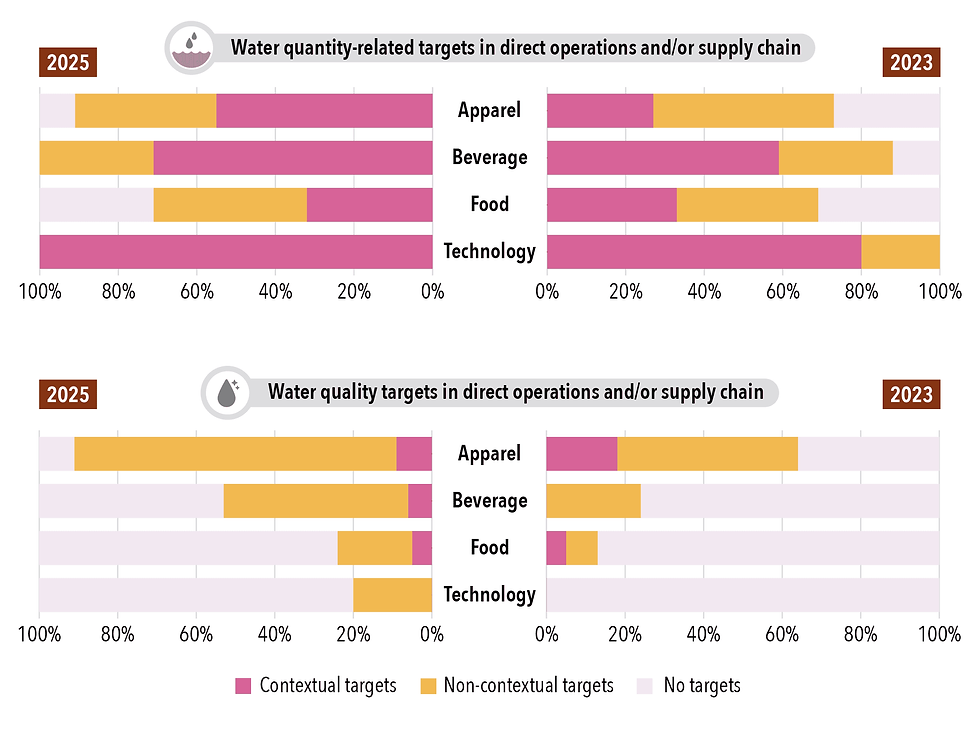
These graphs show the change in targets disclosed by companies between the previous benchmark carried out in 2023 and 2025 for water quantity and quality. Note: The technology sample size is lower than the other companies, encompassing just 5 major companies.
Source: Ceres
Sectoral differences are stark. The apparel sector has made the most significant strides in a number of areas, whereas the food industry has stagnated. The technology sector leads in setting contextual water quantity targets, with all companies in the dataset setting location-specific goals for 2025, up from 80% in 2023 (the first year the biennial benchmarking report was carried out). However, disclosures of withdrawal and consumption volumes have regressed, potentially owing to a lack of consistent mandatory reporting legislation where these companies are concentrated, in the US and East Asia. The beverage industry on the other hand, is a clear leader in disclosures, but has not translated strong data collection into contextual targets that can drive progress where it is most needed.
The technology sector dominates in setting contextual water quantity targets, reflecting the sector’s centralised operations and regulatory scrutiny, making it easier to implement precise, context-driven management strategies. Beverage companies also show strong progress, with the number of contextual targets rising from 59% in 2023 to 71% in 2025, driven by high water dependency and regulatory requirements. Apparel companies have increased contextual targets from 27% to 55%, with Kering becoming the first company in the industry to adopt Science-Based Targets for water quantity, but many still struggle to set these due to complex, fragmented supply chains. In comparison, the food sector’s progress on contextual targets is flat, reflecting the challenge of implementing site-specific goals across varied geographies and highly diverse raw materials.
Water quality targets show even greater disparity. In 2025, only 9% of apparel companies had contextual water quality targets, with 82% relying on non-contextual targets and 9% having no targets at all. Beverage and food companies show similar patterns, with most companies either lacking targets or opting for non-contextual ones, despite stricter regulations and reputational risks. The technology sector, despite its progress on quantity, lags on quality, with 80% of companies reporting no targets in 2025, a reflection of lower direct discharges, less polluted water and less reputational and regulatory pressure when compared with quantity.
WATER VOLUMES DISCLOSED
These graphs show the change in water volumes disclosed by companies between the previous benchmark carried out in 2023, and 2025.

Source: Ceres
Disclosure practices further highlight industry-specific challenges. The beverage sector has made strides in transparency, with disclosure rates for withdrawal and consumption in direct operations rising from 76% in 2023 to 94% in 2025, driven by stakeholder expectations and regulatory demands. The technology industry is making mixed progress, with discharge disclosures increasing, while one of the five companies in the sample stopped disclosing consumption and withdrawal.
Apparel companies lead the way as the only industry to disclose for direct operations and partial supply chain, at 27% for withdrawals and consumption and 18% for discharge, up from 0% in 2023. Reputational pressures and growing engagement with sustainability frameworks are likely driving this.
Governance and advocacy practices are also evolving, particularly in apparel, where 73% of companies reported board oversight of both risks and incentives linked to water in 2025, up from 55% in 2023. Proactive advocacy for water-related issues has surged, especially in apparel (91% in 2025 versus 36% in 2023) and technology (80% versus 60%), driven by regulatory scrutiny and investor expectations.
The Ceres VFWI Benchmark results reflect varying levels of maturity, regulatory pressure, and stakeholder engagement across industries. While progress is evident, especially in contextual target-setting and disclosure, significant gaps remain, particularly in water quality management and equitable access. Without stronger integration of water risks into business planning and governance, alongside urgent, coordinated action to achieve 2030 targets, companies may face mounting financial and reputational exposure.


Comments