Water reporting 'A list' doubles in 2025 as industries take note

Updated: Mar 3
Companies are taking the hint on water as investors push for stronger action on corporate stewardship, according to new figures from disclosure body CDP.
The number of companies awarded an A rating for water in the CDP’s annual questionnaire almost doubled in 2025 as water became a growing priority in corporate sustainability strategies. 263 companies received an A for water in the most recent list, compared to just 133 in 2024.
CDP’s 2025 questionnaire analysed the disclosed sustainability efforts of over 22,000 companies worldwide. There was a 5% increase in the overall number of water scores awarded this year, while 877 companies (4%) made it onto the top-performing "A List" across climate, forests, or water. Companies that received an A rating for water for the first time include H&M Group, Puma, Heineken and Lenovo, while 23 companies attained a "Triple A" rating on all three categories, including L’Oréal, Danone and LVMH.
Countries in Asia and Europe continue to stand out as frontrunners, recording the highest share of A List companies relative to the number of companies assessed. Capital market pressure and government support for disclosure in Asia have sustained high levels of engagement and top-tier scores in recent years, particularly from Japan.
“The market increasingly understands that water is business-critical, not only in direct operations but in supply chains too,” Joe Ray, head of water at CDP, told GWI. “We are seeing a gradual reframing of water, particularly among market leaders, as not only a risk to be managed but an opportunity for value creation.”
'A SCORES' IN WATER BY INDUSTRY (2025 vs 2024)
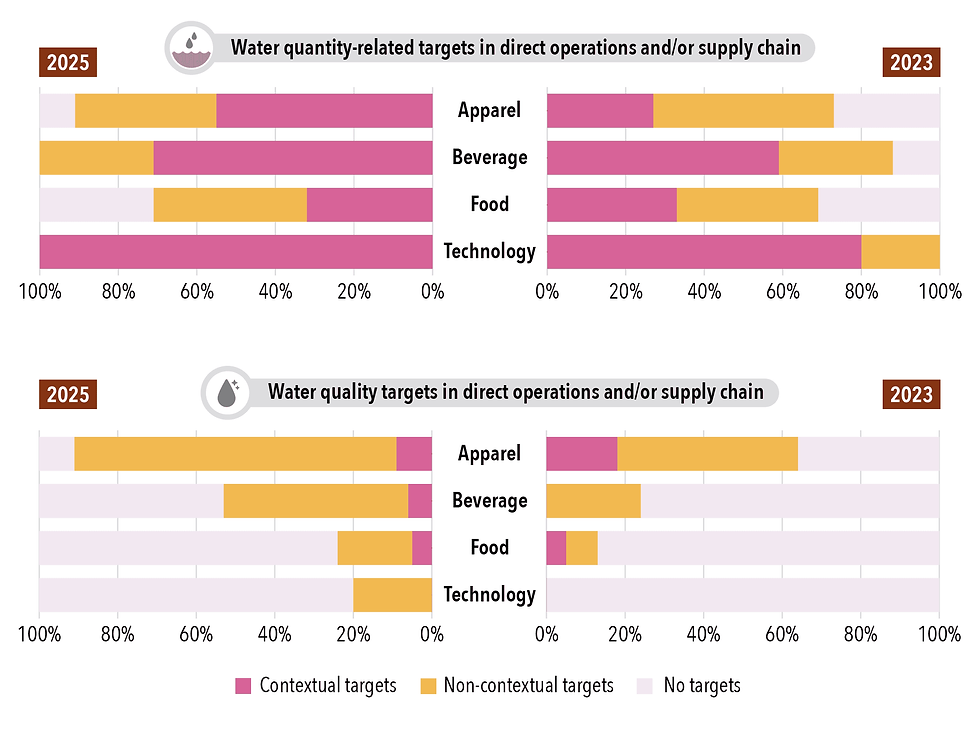
The industrial technology & electronics and food, beverage & agriculture industries lead the pack in 2025's CDP scoring, although all sectors saw an increase in A scores that year. Heavy industries remain underrepresented among top scorers; however, several mining and metal processing companies have received an A for the first time this year, including Gold Fields and Proterial.

The investor lens
The increase in action on water comes as investors place growing pressure on companies to assess their nature-related risks and opportunities, with water increasingly viewed as a decision-useful and measurable nature-related metric. 640 investors, representing $127 trillion in assets, called on companies to disclose through the CDP for the 2025 cycle. While this figure has fallen slightly from 2024, the rise in high scores across both water and forests in 2025 suggests companies are responding to investor expectations and addressing climate, water and nature risks as interconnected issues.
“Boards are becoming more attuned, and there is a growing realisation that water-related risks are material for many organisations,” Emily McKenzie, technical director at the Taskforce for Nature-Related Financial Disclosures, a market-led initiative supporting nature disclosures, told GWI. "There are already examples where companies that are unable to, or choose not to, disclose are facing significant consequences, which include restricted access to capital, higher cost of capital and increased scrutiny.” These kinds of financial consequences can be particularly apparent for industries that rely heavily on ecosystem services to operate, such as agriculture, energy and mining.
Despite the positive trend shown in the latest CDP results, a recent benchmarking of company water strategies by Ceres, an investor-centred water finance initiative, has indicated that companies still need to go further to fully meet investors’ needs. The benchmark found that, while board-level oversight of water is increasing, water-related risks and opportunities remain insufficiently integrated into business planning.
“Senior-level executives at companies are starting to directly engage on water-related issues,” Kirsten James, senior program director for water at Ceres, told GWI. “The question is how that translates into actual business strategy.” For companies wanting to act, the localised nature of water risk can pose a significant starting challenge, while long and opaque supply chains often obscure where potential opportunities lie.
The textile and leather supply chain faces many of these challenges. However, with ‘A’ scores for water more than doubling in this sector, companies are pushing harder to mitigate their water-related risks. GWI’s new industry framework, made in collaboration with ‘A List’ textile and leather companies including Kering, LVMH and H&M Group, is set to provide a common language and methodology for water management and stewardship in the textile and leather industry.
Access the new industry framework A Common Water Framework for the Textile and Leather Industry here.


Comments